Showing posts with label Google. Show all posts

Google Probe: Meet the FTC’s Secret Weapon

San Francisco — The Federal Trade Commission has hired an outside litigator to lead its antitrust probe of Google, FTC Chairman Jon Leibowitz said Thursday during a visit to the agency’s‘s Western Region office here.

The search giant is getting some serious treatment. This is the first time in at least four years the FTC has had anyone other than internal staff run a major investigation.

The outside litigator in question: Beth Wilkinson. She’s a partner at the international law firm Paul, Weiss and previously helped secure a conviction against Oklahoma City bomber Timothy McVeigh. She will begin work on the Google case Monday.

“We want to bring in someone who is a world class litigator and has some antitrust experience and the trust of the commission,” Leibowitz told a small group of reporters.

Wilkinson previously chaired the white-collar crime group at the law firm Latham & Watkins. She also worked in-house for the mortgage company Fannie Mae for several years. Wilkinson began her legal career in the U.S. Army, where she achieved the rank of captain and was an assistant to the general counsel of the Army for Intelligence & Special Operations from 1987 to 1991, according to her bio page on the Paul, Weiss site.

Leibowitz announced Wilkinson’s addition to the FTC’s Google investigation team while in San Francisco visiting a number of startups and tech companies including Square, Mozilla and others.

The FTC is investigating Google’s search business for anti-competition infractions. The investigation does not necessarily mean the FTC will sue Google, but it does pave the way for possible litigation.

“In an important case, you want to do a thorough investigation and make sure you get it right,” Leibowitz said Thursday. “It’s sometimes a good idea to bring someone in from outside and we found out Beth was interested in coming aboard. The commission talked about it and we thought it would be great for the consumers we represent.”

Also Thursday, Google agreed to pay a $25,000 fine — less than the cost of a day’s lunch for its employees — for allegedly impeding a Federal Communications Commission investigation into personal emails and other data collected via the company’s Street View cars.

This article source from : Mashable US & World
Saturday, April 28, 2012 by 2

Spanning Stats Has Scanned 25,000+ Google Drives

Spanning, which already offers a backup service for Google Apps, is now riding the coattails of Google Drive, promising to help people see, “What’s in your Google Drive?”

Two days after the Drive announcement, Spanning released a free tool called Spanning Stats that analyzes your Google Drive account. The company says its report provides data including the percentage documents in your Google Drive by type, the 10 newest and oldest files, how much of the total storage quota you’re using by file type, the 10 biggest files, and the 10 users using the most storage space.

It sounds like there were people who really wanted to see those charts and graphs. The company now says that people have used Spanning Stats to scan 25,000 Google Drives. The app is now listed as one of the top installs in the Google Apps Marketplace and the number one install in the Document Management category.

That probably also reflects the initial excitement about Google Drive. In fact, after the announcement, the the data uploaded to Google Docs by Spanning users exploded — before the announcement, the average amount per day was 5 megabytes, but on the day Google Drive launched it went up to 36.8 megabytes, and then 22.6 megabytes the next day.

Source from : TechCrunch
by 0

Google Drive Arrives In ChromeOS Developer Channel

Ever since Google released its cloud storage service Google Drive earlier this week, there has been some speculation as to what its integration with ChromeOS, Google’s cloud-centric operating system, would look like. Today, Google released the first developer version of ChromeOS 20 with support for Google Drive. As expected, Google Drive is now deeply integrated into the ChromeOS file manager, though this is clearly just a first effort and still needs quite a bit of work.

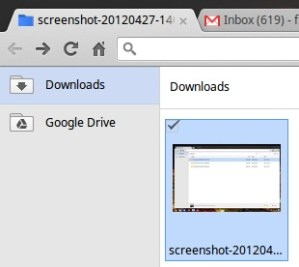
The Google Drive integration is rather basic in this first release. Drive currently appears as an additional folder in the ChromeOS file manager. While the file manager now features a column called “available offline,” I wasn’t able to actually find a way to download my Google Drive files to the laptop’s internal storage, though.

There also wasn’t a clear path for uploading files from the file manager to Google Drive (though you can obviously always use the Drive web app to upload and download files). It’s obviously only a matter of time before this functionality becomes available, though. For now, Google Drive’s advanced search features also aren’t available through the file manager’s interface.

Adding support for Google Drive also puts more emphasis on the file manager in ChromeOS. In the early days of ChromeOS, the file manager was more or less hidden from sight. Over time, though, it clearly became obvious to Google that its users weren’t quite ready for an OS without the ability to manage their files in the way they had become accustomed to.

If you haven’t looked at the developer versions of ChromeOS for a while, you will notice that it looks quite a bit different now compared to just a few weeks ago. Google now uses Aura, a hardware-accelerated window manager for ChromeOS, which allows you to open multiple browser windows and not just one window like before. ChromeOS now also features a Windows-like taskbar at the bottom of the screen.

Source from : TechCrunch
Friday, April 27, 2012 by 0

Facebook’s Patent Acquisitions? They’re More About Google Than Yahoo

In the past few months, Facebook’s patent portfolio has grown exponentially as a result of acquisitions of patent portfolios from IBM and Microsoft. After acquiring 650 AOL patents and patent applications from Microsoft, the company now has approximately 1,400 patent assets. Amazingly, only 46 of these assets (24 issued patents and 22 published applications) were originally filed by Facebook.

In recent years, Facebook has consistently looked to the outside to augment its IP holdings with strategic acquisitions of patent assets. The company paid 40 million for the Friendster social networking patent portfolio, acquired a group of patents from Walker Digital, and another from Hewlett-Packard. These deals expanded the portfolio to approximately 160 patent assets prior to Yahoo’s lawsuit being filed. After Facebook’s IPO decision, and the subsequent patent suit by Yahoo, Facebook has kicked its patent acquisition program into overdrive.

Many point to the Yahoo lawsuit as the reason for the Microsoft and IBM acquisitions. The the AOL portfolio could useful to Facebook in defending itself against Yahoo. However, now Yahoo is trying to have other patents Facebook bought after being sued by the web portal invalidated because Facebook purchased them specifically to use in a retaliatory counter-suit. In any case, it would have been significantly cheaper for Facebook to settle with Yahoo instead of taking this aggressive approach.

So who is Facebook so worried about that it would spend so much on buying intellectual property? The types of patents being acquired tell part of the story. Facebook has emphasized acquiring older assets, which it could not have developed on its own. Facebook’s oldest patent was filed in 2004, the same year the company was created. A typical patent application currently takes approximately 3-4 years to be issued. Developing a patent portfolio in the social networking space is challenging because the popularity of social networking companies has resulted in the space being littered with both patent and non-patent prior art. As a result, companies, such as Facebook, that initially largely ignored growing their IP portfolios, cannot rely on filing its own applications to develop a substantive IP portfolio.

The IBM and AOL patent acquisitions give Facebook access to IP that is significantly older than Facebook’s own IP. Older patents are subject to fewer prior art, making them more difficult to defend against. In addition, older patents provide leverage for the asserting party by allowing collection of up to six years of damages from the infringer. Such patents are therefore especially helpful in dealing with established parties having significant resources and sophisticated legal teams.

The technology areas of the IBM and AOL patents are also telling. The patents Facebook acquired from IBM are rumored to be in the networking and software space. AOL’s patents are largely directed to email, instant messaging, web browsing, search, ads, mobile, & ecommerce. Together, these are technology areas that Facebook likely never expected to find itself competing in when the company was first founded because it may not have realized that their product would evolve into the messaging/advertising/ecommerce platform that it is today. These are also technology areas that are core to Google, one of Facebook’s biggest threats.

In the past year, Google introduced Google+, a direct competitor and challenger to Facebook. While Google+ has only had moderate success to date, Facebook likely felt exposed against Google’s significantly larger and ever-expanding patent portfolio. These patent acquisitions provide Facebook with some protection as the competition between the two companies heats up. In addition, the rumors of an Android-based Facebook phone have been revived, which could bring Facebook directly into the litigious mobile space, where Google is one of the main players.

Interestingly, this is not the first time that Facebook and Microsoft have worked together with Google in mind. In October 2007, the two companies entered into an Internet advertising partnership. That deal was seen as a way for Microsoft to counter Google’s Internet advertising position. It makes sense that the two companies would again collaborate to respond to a potential threat from Google.

Thus, while the acquisitions may be helpful to Facebook in dealing with Yahoo, it is likely that these acquisitions have less to do with Yahoo than with Facebook’s anticipation of future litigation. Specifically, Facebook appears to be preparing for increased competition with Google. It bears watching whether the companies will look to their patent acquisitions as part of this strategy. Of course, such protection has the added benefit of helping to increase Facebook’s IPO value, making this decision a no-brainer for the company.

Source from : TechCrunch
by 0

How Does Google Drive Compare to the Competition?

Now that Google Drive is finally a reality, how does it stack up against the cloud competition?

Google’s new cloud-based document and storage solution is priced aggressively and boasts best-in-class integration with other Google services — including Google Docs. As you can see from our hands-on, Google Drive is an impressive product.

Still, the cloud storage and collaboration space is more competitive than ever before. Google faces competition not just from cloud companies such as Box and Dropbox, but from Apple, Microsoft and Amazon as well.


Storage and Pricing


Google is pricing Google Drive at a VERY aggressive level. For $30 a year ($2.50 a month), users get 25GB to use for Google Drive and Picasa, plus 25GB of Gmail storage.

This is more than what Amazon and Microsoft charge for an additional 20GB, but less than the price of Dropbox, Apple and Box.net.

For $60 a year ($5 a month), Google offers 100GB of Drive and Picasa storage (plus 25GB for Gmail), which clocks in below Amazon, Apple, Dropbox and Box.net. For penny pinchers, Microsoft’s offer of 100GB of additional storage — on top of the 7 or 25GB that users already get with the service — is just $50 a year.

Dropbox and Box are among the more expensive services.

A 100GB Dropbox account costs more than three times what a Google Drive account costs. In this area, Google is clearly trying to undermine its competition on a per-GB pricing basis.

In the case of Box, the company’s real focus is on business users. Box’s pricing is also significantly higher than Google Drive; however, that differentiation is also part of the company’s focus. As Box has told us on multiple occasions, it wants to replace Microsoft SharePoint in the SMB and Enterprise space. While Google is also looking in this direction, Box has a bevy of services and integrations that are focused on replacing a company’s central file server.


Upload Limit


The most limiting factor of the majority of cloud storage and collaboration services isn’t the total amount of storage — it’s the limitations on upload size.

Google has an impressive 10GB limit on files or folders. This is significantly more than the 2GB limit imposed by most cloud services. Only Dropbox’s desktop apps for Mac, Windows and Linux do better. With Dropbox, the only limitation is the size of a storage plan.


Collaboration and Sharing


Like Microsoft’s SkyDrive and Box, Google Drive offers in-browser access to files and folders, including document editing via Google Docs.

And like SkyDrive, Box and iCloud, third-party applications can plug into Google Drive to retrieve or store files. This makes keeping apps synchronized across devices and platforms much more seamless.


Mobile Integration


Although Google Drive’s Android app is already around, Google is making iOS users wait for access to the app. This is in contrast to Dropbox, Box and SkyDrive, which all offer official or unofficial solutions for multiple mobile platforms.

Amazon and Apple are behind in the mobile access game. Apple makes iCloud exclusively available to iOS 5 users, and Amazon’s Cloud Drive only integrates with Android (and the integration is limited at that).


Desktop Integration


Part of the reason that Dropbox has such a loyal following is because of its fantastic Desktop integration. Mac, Windows and Linux users can automatically sync and share files from their native file systems without having to bother with desktop uploads.

This is a similar approach to the one Box has taken with its Box Sync service for Windows, and to what Microsoft employs for SkyDrive for Windows and Mac.

Google Drive’s desktop app works essentially the same as SkyDrive — in other words, it isn’t as tightly coupled with the file system as Dropbox, but it does the job.


Final Thoughts


Which cloud storage service an individual or business decides to use is a decision that should encompass more than just comparing specs and pricing. Take time to use a service and see how it integrates into your workflow before plunking down cash on an upgrade.

For users and businesses heavily tied to Google Docs, Google Drive will likely make sense. For those that love Dropbox or need some of Box’s more robust features, Google Drive might not fit the bill. For Microsoft Office users, consider giving Microsoft SkyDrive a try — it works well and also offers online access to basic web and editing apps.

Ultimately, neither offering from Apple nor Amazon is likely to compete with Google Drive — the products are focused on different use cases.

We’d also like to give Canonical’s Ubuntu One a shout-out. We didn’t include it in our direct comparison because of its more limited options, but for Windows and Ubuntu users, its free service is worth a look as well.

Tell us your thoughts on the cloud storage and collaboration space. Does Google Drive have the goods to compete? Let us know in the comments.

Article and thumbnal image, take it from : Mashable Tech
by 0

U.S. Escalates Google Case by Hiring Noted Outside Lawyer

Federal regulators escalated their antitrust investigation of Google on Thursday by hiring a prominent litigator, sending a strong signal that they are prepared to take the Internet giant to court.

The Federal Trade Commission is examining Google’s immensely powerful and lucrative search technology, which directs users to hundreds of millions of online and offline destinations every day. The case has the potential to be the biggest showdown between regulators and Silicon Valley since the government took on Microsoft 14 years ago.

Then as now, the core question is whether power was abused. The agency’s inquiry has focused on whether Google has manipulated its search results, making it less likely that competing companies or products appear at the top of a results page.

A spokeswoman for Google, which is based in Mountain View, Calif., declined to comment.

Federal Trade Commission officials cautioned that no decision had been made about whether to bring a formal case against Google. But the hiring of Beth A. Wilkinson, a former Justice Department prosecutor who played a lead role in the conviction of the Oklahoma City bomber Timothy McVeigh, immediately catapulted the investigation to another level. The agency has hired outside litigators only twice in the last decade.

“It’s a watershed moment when you hire someone like this,” said David Wales, a former Fed-eral Trade Commission official now in private practice with Jones Day. “This shows Google that if it doesn’t give you the remedy you want, you’re going to litigate.”

Several antitrust experts compared the hiring of Ms. Wilkinson — who has brought about 40 major cases in government and private practice and won them all — to the government’s hiring of David A. Boies to represent it against Microsoft.

“It increases the likelihood that there will be a case,” said Douglas Broder, a law partner at K&L Gates in New York and the author of several textbooks and articles on antitrust law.

The Microsoft case in the late 1990s transformed the tech industry, reining in its most powerful company and allowing for the rise of new companies like Google. Now Google wields the same sort of power that Microsoft once did, and is under the same sort of scrutiny.

It has been involved in one privacy controversy after another over the last year. Indeed, the announcement of the hiring of Ms. Wilkinson — made by the Federal Trade Commission’s chairman, Jon Leibowitz, at a meeting in San Francisco with reporters — eclipsed Google’s formal response earlier Thursday to a fine by the Federal Communications Commission for obstructing a separate investigation.

“In an important case, you want to do a thorough investigation,” Mr. Leibowitz said, calling Ms. Wilkinson “a world-class litigator.”

Ms. Wilkinson is a partner at the law firm of Paul, Weiss in Washington. She previously worked at Latham & Watkins, where she was co-chairwoman of the white-collar crime practice group. Her work at the F.T.C., which will be part-time, begins on Monday.

“Technology is transforming our society,” Ms. Wilkinson said in an interview. “It affects people at every level. As a mother, I see it with my kids. As a professional, I see it affecting our work. And in society, it impacts privacy, competition, our interactions with other people — just about everything.”

She added: “Working on the investigation will be a great challenge. I don’t underestimate Google.”

No one else was underestimating it Thursday either.

Mr. Broder said antitrust cases charging the abuse of a monopoly are difficult to prove.

“There is a lot of very complex economics involved,” he said. “It can be done. But Google will undoubtedly bring to bear tremendous resources itself.”

Any decision about filing a suit is likely to be months away.

Article and thumbnail image, source from : NY Times
by 0

Google Actually Sells a Service: Sketchup is Going to Trimble

Google announced Thursday that it was selling 3D modelling tool SketchUp — an unusual event for the tech giant known more for aqcuiring companies than for selling them.

Trimble Navigation is purchasing the platform for an undisclosed amount of money.

Google acquired SketchUp in 2006 and has used the tool to design building models within Google Earth.

“In its time at Google, SketchUp has become one of the most popular 3D modeling tools in the world,” SketchUp wrote on its official Google blog. “With over 30 million SketchUp activations in just the last year, we’re awfully proud of our accomplishments. But there’s still so much we want to do, and we think we’ve found a way forward that will benefit everyone—our product, our team and especially our millions of users.”


Trimble, the new parent of SketchUp, makes surveying, mapping and marine navigation equipment. SketchUp says Trimble’s commitment will help the platform return to its core communities — both veteran and new modelers, designers and makers — which it calls its heart and soul.

SketchUp says it will keep the free version of the platform, which is used by a wider audience.

Do you think SketchUp will be better served by Trimble, a more niche parent company than Google? Sound off in the comments.

Source from : Mashable Tech
by 0

Google Translate Draws 200 Million Users Each Month

Google announced on Thursday that its popular language translator service Google Translate now boasts 200 million monthly users, many of whom are accessing it outside the U.S. and via mobile devices.

The news — which comes just two days before Google Translate’s sixth anniversary — shows an increasing desire to communicate with others regardless of language, not only online but offline too.

Google Translate allows users to access and interpret webpages on servers thousands of miles away. The company started to offer a basic translating service in 2001 for eight languages and later expanded to more languages in 2003.


“But at that time our system was too slow to run as a practical service—it took us 40 hours and 1,000 machines to translate 1,000 sentences,” Franz Och, principal scientist at Google, said in a company statement. “So we focused on speed, and a year later our system could translate a sentence in under a second, and with better quality. In early 2006, we rolled out our first languages: Chinese, then Arabic.” The service now offers 64 languages, including many with a small web presence such as Bengali, Yiddish and Esperanto.

In addition to the 200 million monthly active users on translate.google.com, consumers are also accessing Google Translate in other ways, such as via Chrome, mobile apps and YouTube.

More consumers are also accessing Google Translate while traveling than ever before. The company reported its mobile traffic to the service has more than quadrupled year over year. Meanwhile, more than 92% of traffic from Google Translate comes from international users outside the U.S.

Usage is so high that it translates the equivalent of 1 million books each day.

“We imagine a future where anyone in the world can consume and share any information, no matter what language it’s in, and no matter where it pops up,” Och said. “We already provide translation for webpages on the fly as you browse in Chrome, text in mobile photos, YouTube video captions, and speech-to-speech “conversation mode” on smartphones. We want to knock down the language barrier wherever it trips people up, and we can’t wait to see what the next six years will bring.”

Thumbnail via iStockphoto, franckreporter.

This articel source from : Mashable Tech
by 0

Google Adds a ‘Share’ Button for Google+

Lost amid the hysteria over Google‘s powerful new Drive cloud-storage service was another product introduced by the Mountain View tech giant on Tuesday — a Google+ “Share” button.

The new button enables website operators to more easily encourage visitors to spread content among connections on Google’s social network. It’s the latest step in integrating the social network with content across the web. The Share button joins the already existing +1 button, which enables Google+ members to indicate that they — for lack of a better term — like a page or an article.

“When your visitors come across something interesting on your site, sometimes you want to encourage a simple endorsement (like +1),” Google+ product manager Rick Borovoy wrote in a blog post introducing the new feature. “Other times, however, you want to help visitors share with their friends, right away. Today’s new Google+ Share button lets you do just that.”

When visitors click the button, they have the option of sharing a page with specific people or Circles in their network. Like with the +1 feature, the new button switches from red font on a light background to light font on a red background after being clicked. Users can click the button multiple times, however, to share repeatedly or in different contexts with different segments of their network.

The Share button is now available globally. How do you add it to your site? Visit the Google Developers’ site or get the code here.

Source from : Mashable Social Media
by 0